
Most homes get cluttered from time to time. A crowded garage, piles of paperwork, an overfilled closet, or boxes waiting to be sorted do not automatically mean someone has a hoarding problem.
The concern increases when possessions begin taking over living spaces, rooms can no longer be used for their intended purpose, exits or walkways become difficult to access, sanitation deteriorates, or conditions begin creating health and safety hazards.
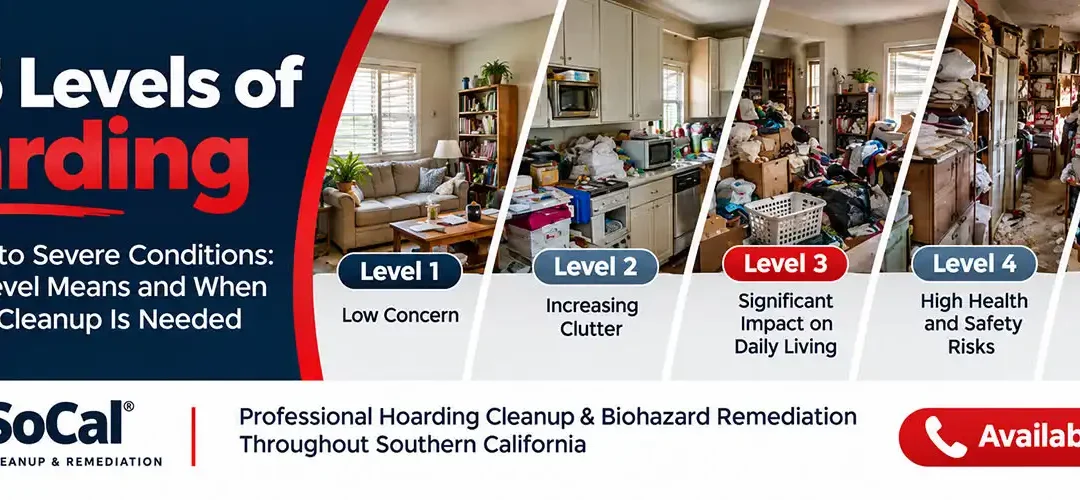
One useful way professionals evaluate these environments is through the five levels of hoarding, ranging from relatively minor clutter at Level 1 to severe environmental and safety concerns at Level 5.
At Bio SoCal, we are often called when a hoarded home has progressed beyond ordinary clutter and contains conditions such as animal waste, human waste, spoiled food, insects, rodents, bodily fluids, strong odors, or other biohazards.
Understanding the five levels can help families, property managers, landlords, and other responsible parties recognize when a situation may require more than basic organizing or junk removal.
What Are the 5 Levels of Hoarding?
The five-level system commonly used to evaluate hoarded environments looks at more than simply how many possessions are inside a home.
It considers factors such as:
- Whether rooms can still be used normally
- Access to doors, hallways, stairs, and exits
- Plumbing, electrical, heating, and cooling systems
- Structural conditions
- Sanitation
- Pest and rodent activity
- Animals inside the home
- Health and safety hazards
- The amount and location of clutter
The levels progress from Level 1, representing relatively low environmental concern, through Level 5, representing severe conditions that may require multiple professionals to safely address.
It is also important to understand that these levels are an environmental assessment tool. They are not a diagnosis of hoarding disorder.
Level 1 Hoarding: Low Environmental Concern
At Level 1, the home generally remains functional.
There may be some clutter, but rooms are still accessible and can be used for their intended purposes. Entrances and exits remain clear, utilities are functioning, and there are typically no significant sanitation concerns.
Someone may have more belongings than the average household, but the condition of the property itself generally does not present a serious health or safety concern.
Examples may include:
- Crowded closets or storage spaces
- Boxes or belongings accumulating in certain areas
- Minor housekeeping issues
- Some excess possessions without blocked living spaces
- Rooms that remain functional
At this stage, organizing, decluttering, or ordinary housekeeping may be all that is needed.
From a biohazard standpoint, a Level 1 home generally would not require professional biohazard remediation unless there is a separate contamination issue present.
Level 2 Hoarding: Clutter Is Becoming More Noticeable
At Level 2, clutter becomes more established and may begin affecting how parts of the home are used.
There may be increased accumulation in bedrooms, kitchens, garages, or living areas. Some maintenance or housekeeping problems may also begin appearing.
Potential signs can include:
- Increasingly crowded rooms
- Narrower walking paths
- Excessive storage of possessions
- Delayed home maintenance
- Stronger household odors
- Minor sanitation concerns
- Early evidence of insects or pests
- Difficulty accessing some furniture or appliances
The home may still be largely functional, but it is becoming harder to maintain.
This can be an important stage for intervention because relatively manageable clutter can continue to build over time.
Professional organizers, family assistance, junk removal, or other support may be appropriate depending on the circumstances.
If rodent droppings, animal waste, bodily fluids, spoiled food, or other biological contamination is present, specialized cleaning may also be necessary.
Level 3 Hoarding: The Turning Point
Level 3 is often considered an important turning point between a cluttered household and an environment that may require more specialized intervention.
At this stage, clutter can significantly interfere with normal household functions.
Rooms may no longer be usable for their intended purpose. A dining table may disappear beneath possessions. A bedroom may become too crowded to comfortably sleep in. Kitchen counters, sinks, or appliances may become inaccessible.
Conditions may include:
- Significant clutter throughout multiple rooms
- Narrow pathways through the home
- Rooms that can no longer be used normally
- Increased dust and debris
- Spoiled or expired food
- Noticeable odors
- Insect or rodent activity
- Animal waste
- Plumbing or maintenance issues
- Increasing sanitation problems
This is also where Bio SoCal may begin encountering situations involving biohazard contamination.
For example, rodent infestations can leave droppings and urine throughout a property. Pets may begin eliminating indoors because access to appropriate areas is blocked or cleaning has become difficult. Food waste may attract insects and rodents.
At this point, simply removing possessions may not be enough.
The property may also need specialized cleaning, disinfection, pest control, repairs, and other professional services.
Level 4 Hoarding: High Health and Safety Risk
At Level 4, conditions inside the home can present substantial health and safety concerns.
The volume of belongings may severely restrict movement through the property. Multiple rooms may be unusable, exits can become difficult to reach, and basic household systems may no longer function properly.
Environmental hazards may include:
- Extensive clutter throughout the property
- Blocked or severely restricted walkways
- Inaccessible rooms
- Heavy dust and debris
- Rodent or insect infestations
- Significant animal urine or feces
- Human waste
- Rotting or spoiled food
- Strong odors
- Nonfunctioning plumbing
- Structural deterioration
- Unsafe electrical conditions
- Accumulated garbage
Fire safety can also become a major concern.
Large amounts of combustible material, restricted pathways, blocked exits, and limited access for emergency responders can make an already dangerous situation significantly worse.
Level 4 environments often require a coordinated effort involving several types of professionals.
Depending on the property, that may include professional organizers, biohazard cleanup companies, pest control professionals, contractors, social-service professionals, property managers, or other specialists.
Level 5 Hoarding: Severe and Potentially Hazardous Conditions
Level 5 represents the most severe end of the environmental scale.
The property may contain extreme amounts of clutter along with serious sanitation, structural, pest, animal, or biohazard concerns.
Living conditions may have deteriorated to the point where portions of the home—or the entire home—are unsafe or unusable.
Possible conditions include:
- Extreme clutter throughout most or all living spaces
- Rooms that cannot be entered or used
- Blocked doors, hallways, or exits
- Large amounts of garbage
- Severe pest or rodent infestations
- Significant animal feces and urine
- Human feces or urine
- Decomposing food
- Dead animals or animal remains
- Bodily fluids
- Severe odors
- Plumbing failures
- Structural damage
- Electrical hazards
- Fire hazards
In some circumstances, authorities, building management, code enforcement, adult protective services, or other agencies may already be involved.
A Level 5 cleanup should not be approached as simply a large junk-removal job.
There may be multiple overlapping risks inside the property, and the cleanup may require careful planning and coordination among several professionals.
When Does Hoarding Become a Biohazard?
Clutter itself is not necessarily a biohazard.
A home can contain an enormous amount of property without containing biological contamination.
The situation becomes different when the environment contains potentially hazardous biological material such as:
- Human feces or urine
- Animal feces or urine
- Rodent droppings and urine
- Blood or bodily fluids
- Decomposing animals
- Contaminated food waste
- Needles or sharps
- Materials contaminated by biological fluids
These conditions are more commonly encountered as hoarding environments become more severe, although a biohazard can occur at any level.
This distinction is important because junk removal, organizing, housekeeping, and biohazard remediation are not the same service.
A junk-removal company can remove unwanted furniture and possessions. A professional organizer can help someone sort and manage belongings. A cleaning company can perform routine household cleaning.
When biological contamination is present, however, additional precautions may be necessary to safely remove contaminated materials, clean affected surfaces, disinfect appropriate areas, and properly handle regulated waste.
Animal Waste Can Become a Major Issue in Hoarded Homes
One of the more difficult situations involves animals living in heavily cluttered properties.
When a home contains multiple animals—or when clutter makes normal cleaning difficult—feces and urine can accumulate beneath furniture, boxes, clothing, carpeting, and other possessions.
The visible contamination may only be part of the problem.
Urine can penetrate carpet, padding, flooring, wood, drywall, and other porous materials. Feces may be found beneath layers of belongings that have not been moved for months or years.
In severe environments, dead rodents or other animal remains may also be discovered during the cleanup.
These conditions may require removal of contaminated materials in addition to cleaning and disinfection.
Hoarding Cleanup Is Often More Than Removing Belongings
One of the biggest misconceptions about hoarding cleanup is that the solution is simply bringing in a dumpster and throwing everything away.
Severe hoarding environments can be much more complicated.
A proper cleanup may involve separating salvageable belongings from waste, identifying contaminated materials, removing unsanitary items, cleaning affected surfaces, disinfecting appropriate areas, addressing odors, and determining whether flooring, drywall, cabinetry, or other building materials have been affected.
There can also be important personal belongings mixed throughout the property.
Photographs, legal documents, money, jewelry, family keepsakes, and other important items may be buried among ordinary household contents.
For that reason, these projects should be approached carefully rather than treating everything inside the property as trash.
Compassion Matters During Hoarding Cleanup
Hoarding situations can be difficult for everyone involved.
Family members may be frustrated. Property owners may be overwhelmed. The person living in the home may be embarrassed, fearful, or distressed about losing possessions.
Hoarding disorder is a recognized mental health condition, and simply owning a large number of possessions does not by itself establish that someone has the disorder.
Professional cleanup should focus on the condition of the property and the work necessary to make the environment safer—not on judging the person who lives there.
At Bio SoCal, our role is not to diagnose hoarding disorder.
Our role is to address the cleanup and biohazard conditions we are called to remediate while treating the people involved with dignity and respect.
When Should You Call a Professional Hoarding Cleanup Company?
Professional assistance should be considered when the volume or condition of the contents makes the property difficult to safely manage.
Biohazard cleanup becomes particularly important when there is evidence of:
- Feces or urine
- Blood or bodily fluids
- Significant rodent contamination
- Animal waste
- Decomposition
- Strong biological odors
- Contaminated porous materials
- Other potentially infectious material
If the property also has structural damage, an active pest infestation, utilities that are not functioning, or significant fire hazards, additional licensed professionals may be needed.
In severe Level 4 and Level 5 environments, the safest approach is often a coordinated cleanup plan rather than attempting to solve every problem with a single service.
Professional Hoarding and Biohazard Cleanup in Southern California
Bio SoCal provides professional hoarding cleanup and biohazard remediation throughout Southern California, including Los Angeles County, Orange County, Riverside County, San Bernardino County, and Ventura County.
Our team handles properties where hoarding conditions are accompanied by biological contamination, animal waste, rodent contamination, bodily fluids, decomposition, odors, or other unsafe conditions.
Every property is different.
Some homes primarily need contents removal and deep cleaning. Others contain extensive contamination that requires biohazard remediation and removal of affected materials.
Bio SoCal can evaluate the condition of the property, develop an appropriate cleanup plan, and help determine which services are necessary to safely restore the affected environment.
If you are dealing with a hoarded property and are unsure whether the conditions have progressed beyond ordinary clutter into a biohazard situation, Bio SoCal can help assess the cleanup needs and determine the appropriate next steps.
