
Understanding why this happens and how professional remediation addresses it can help families, landlords, and property managers make informed decisions during an already overwhelming time.
Why Are Body Fluids Released After Death?
Immediately after death, the body begins to undergo predictable physiological changes:
1. Muscle Relaxation
When the heart stops and the brain no longer sends signals to the body, muscles lose tone and fully relax. This includes the muscles that control the bladder and bowels. As a result, urine and feces may be released through the natural orifices of the body.
2. Cellular Breakdown (Autolysis)
Within hours, cells begin to break down in a process known as autolysis. Internal tissues liquefy and release fluids.
3. Decomposition and Gas Formation
As decomposition progresses, bacteria naturally present in the body produce gases. These gases build pressure internally and can force fluids outward.
These processes are natural. They are not unusual, and they are not indicative of the circumstances of death. However, they do create a biohazard condition that must be handled according to established remediation standards.
Why Mattresses and Soft Furniture Are Typically Removed
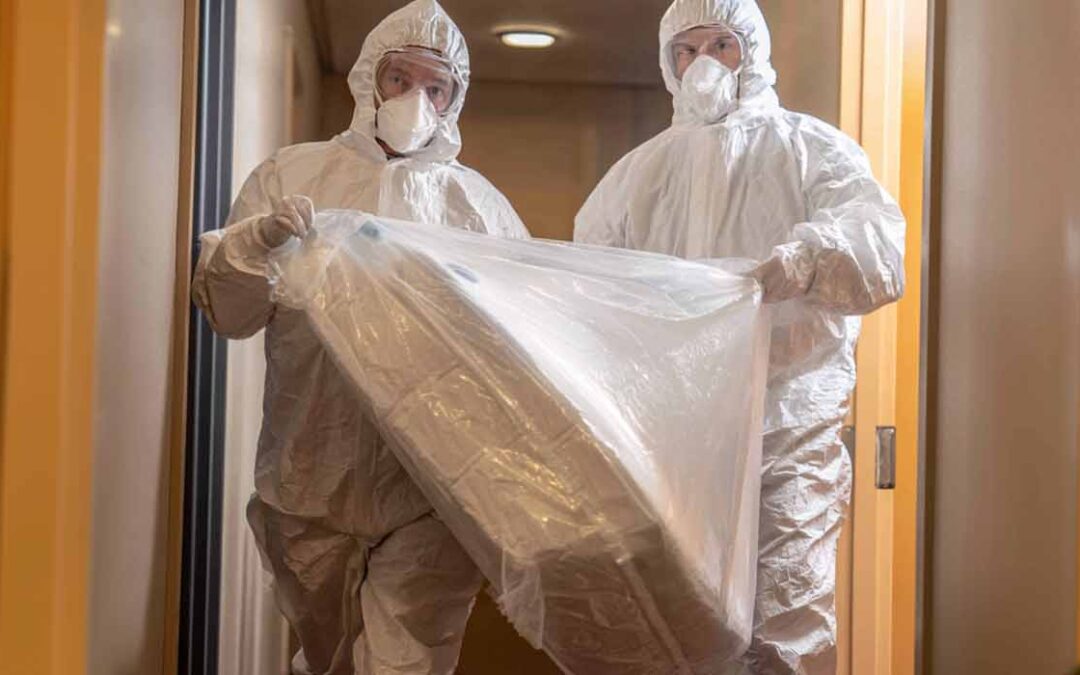
In most unattended deaths, the individual is found in a bed. Because mattresses are soft and porous, fluids are quickly absorbed deep into the interior materials, professional biohazard protocols require that:
- Soft, porous materials be removed rather than cleaned
- Contaminated materials be cut out and properly disposed of
- The affected structure beneath be assessed and remediated
A mattress cannot be adequately disinfected once fluids penetrate its interior layers. For this reason, removal is almost always required.
The same principle applies to:
- Couches and upholstered chairs
- Carpet and carpet padding
- Fabric bed frames
- Area rugs
Attempting to “clean” these materials would not meet health and safety standards.
What About Hard Flooring?
Hard, non-porous surfaces such as tile, sealed concrete, or certain hardwood floors can often be cleaned and disinfected — provided fluids have not seeped into seams, cracks, or joints.
If fluids penetrate:
- Floorboard seams
- Cracks in tile grout
- Gaps in laminate flooring
Then removal of those sections may be necessary to access and properly decontaminate the underlying material.
Why Carpet Must Be Removed
Carpet presents a particular challenge. Even if surface staining appears minimal, fluids frequently:
- Travel through the carpet fibers
- Saturate the carpet padding
- Reach the subfloor beneath
If the padding and subfloor are not accessed, residual contamination can remain trapped below the surface, leading to:
- Persistent odors
- Bacterial growth
- Structural damage
For this reason, protocol typically requires removal of carpet and padding in the affected area. Once removed, the subfloor can be properly cleaned, disinfected, and evaluated for further remediation.
Why Biohazard Standards Require Removal, Not Cleaning
Biohazard remediation follows strict health and safety guidelines. The standard approach is:
Cut out and remove contaminated porous materials rather than attempt to sanitize them.
This protects:
- Future occupants
- Property owners and landlords
- Family members returning to the home
- Workers performing reconstruction
It also ensures the property can be restored safely and appropriately.
The Emotional and Practical Reality
After-death cleanup is not simply about cleaning. It is about restoring a space to a safe condition while respecting the seriousness of what has occurred.
For families, this often means:
- Letting go of certain furniture items
- Understanding why removal is necessary
- Knowing that these decisions are based on health and safety standards, not convenience
For landlords and property managers, it means ensuring the property meets habitable standards before re-occupancy.
A Natural Process in Death
The release of bodily fluids after death is a natural biological process. When it affects beds, carpeting, and furniture, proper remediation requires removal of porous materials and professional decontamination of the underlying structure.
While difficult, these steps are essential to ensure the space is safe, sanitary, and ready for its next chapter.
